
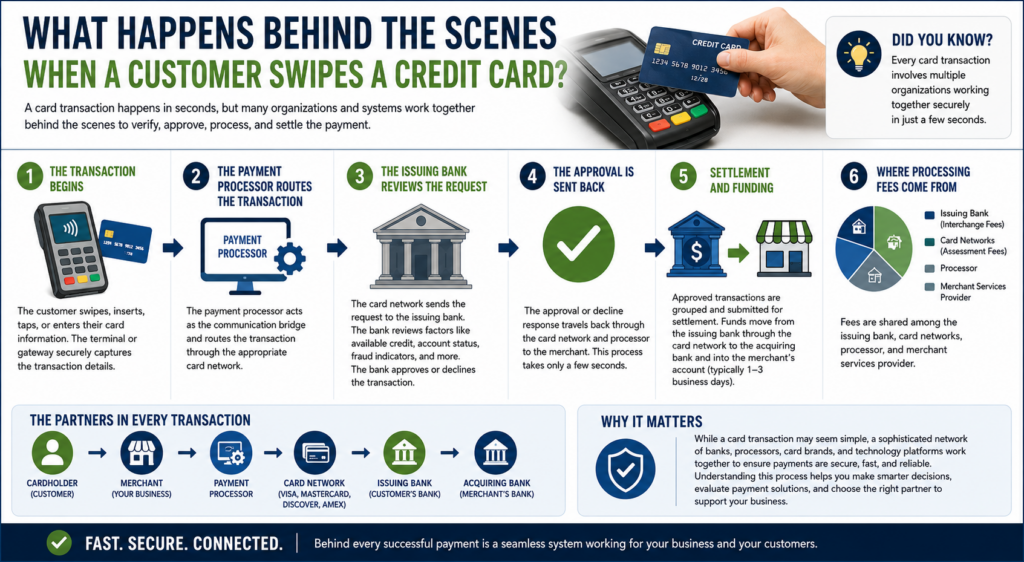
More Happens Than Most People Realize
When a customer swipes, dials, taps, or inputs his or her credit card details, it seems like everything happens immediately. However, there is actually a lot that goes on behind the scenes involving many players to authenticate, authorize, process, and settle the transaction.
Knowing the workings of credit card processing could help you, as an entrepreneur, to make better choices.
Step 1: The Transaction Begins
It begins when a customer makes use of a credit card or a debit card to pay for his/her purchase. It could happen at a traditional point-of-sale terminal, an ecommerce check out page, or a mobile payment app.
The payment terminal or gateway would collect the payment details including the payment amount and the card data.
Step 2: The Payment Processor Routes the Transaction
Once the payment details are captured, the same is forwarded to the payment processor. The payment processor is responsible for providing the connection between the merchant, card network, and the banks.
The payment processor then forwards the transaction request to the corresponding card network, which could be Visa, MasterCard, Discover, and so on.
Step 3: The Issuing Bank Reviews the Request
This is done by the card network sending the transaction to the bank from which the customer received his/her credit or debit card.
The bank checks a number of considerations that include the availability of credit, status of the account, indicators of fraud, spending habits, and transaction data.
From these considerations, the bank will either accept or decline the transaction.
Step 4: The Approval Is Sent Back
The confirmation or declination message goes back through the network to the merchant’s payment terminal or checkout page.
The whole process of authorization normally does not take more than a few seconds.
In case of authorization, the customer is able to make the payment. In case of declination, the merchant asks for some other method of payment.
Step 5: Settlement and Funding
Authorizations do not automatically release any payment. At the end of the business day, all authorized payments are grouped together and then processed during the settlement process.
During the settlement process, the issuer’s bank makes a fund transfer through the credit card company to the acquiring bank, which is the bank that processes the merchant account.
Afterwards, the acquiring bank makes the deposit of funds into the merchant’s account, which typically takes one to three business days.
Where Processing Fees Come From
Many people are involved in each card transaction. Consequently, the processing fees are shared between many entities.
Interchange fees go to the issuing bank. Assessment fees are earned by the card networks. The payment processor and merchant service provider are responsible for fees that are earned during the process of carrying out the transactions.
These fees are what constitute the processing fees charged to the merchants.
Why It Matters
Even though the payment through cards might appear very straightforward to consumers, there is actually a complex system of banks, processors, card companies, and technologies that work in the background to ensure the payment is made securely and quickly.
This will make it easier for the merchants to assess different payment solutions and choose the best one.