
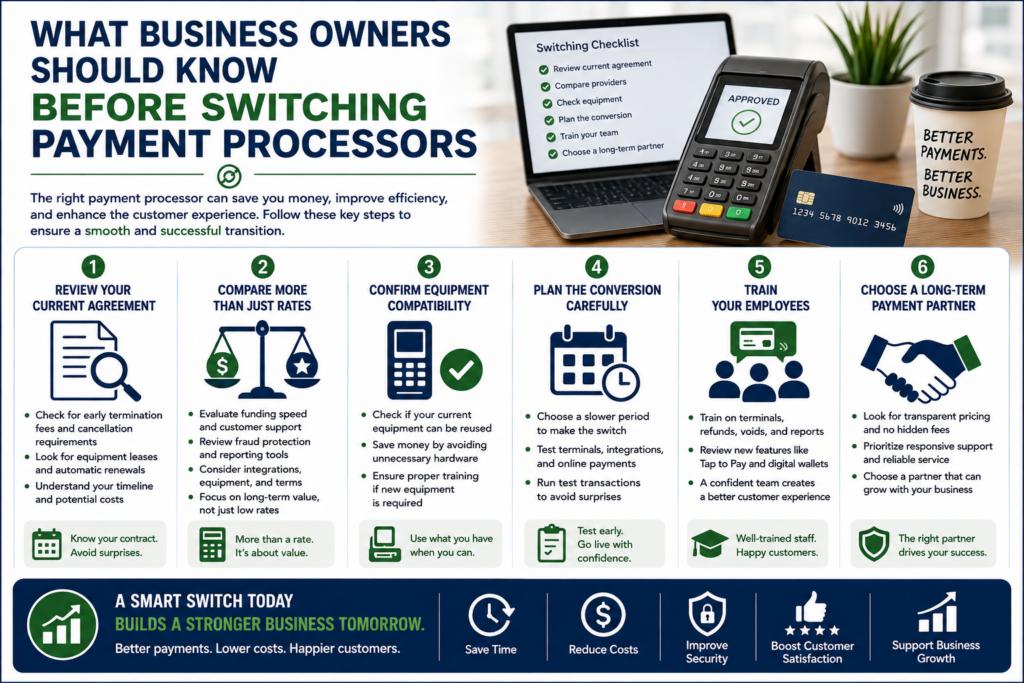
It may appear that changing your payment processor is difficult; however, it is not. Whatever your reasons, whether it be for customer service, cheaper rates, technology upgrades, or added payment capabilities, taking the right steps can help your company save both money and time as well as improve the overall customer experience.
When making this change, there are many important things you should take into consideration.
Review Your Current Agreement
It is best to start with assessing the agreement on the current arrangement of payment processing. Look out for possible early termination fees, equipment lease agreements, and automatic renewal of contract arrangements.
Knowing your current contractual arrangements will help you prepare better for the transition.
Compare More Than Just Rates
Lower processing fees may seem like an enticing proposition, but they should not solely drive your decision-making process. Consider funding speed, support, fraud detection capabilities, reports, hardware choices, software integration, and contract clauses.
Ultimately, a payment processor that offers good service and current technology is likely to offer greater value than one that simply boasts the lowest fee.
Confirm Equipment Compatibility
If your company has existing payment terminals and/or POS systems, find out if the existing hardware can be programmed to work with the new processor.
In most instances, you will be able to save on costs since your company will use existing hardware. However, in case of need for new hardware, train your staff first before implementing changes.
Plan the Conversion Carefully
Select a transition date that falls during periods where business is slower, if possible. This will enable testing of the payment terminal systems, online checkout systems, recurring billing services, and software integrations before regular customer traffic resumes.
Conducting test transactions prior to launch will enable you to identify any problems that might arise.
Train Your Employees
No matter how advanced a payment system is, it will not be successful if your staff is not familiar with its use. Training should be provided on payment systems, refunds, voids, reports, and any new payment processes like Tap to Pay.
Your staff must feel confident to make the transition easier for everyone.
Choose a Long-Term Payment Partner
The cheapest payment processing company is not always the best choice. Seek a payment processor that provides clear pricing, efficient customer service, security measures in payment processing, and options that will help your company to scale up in the future.
Changing payment processors may lead to improvements in efficiency and cost savings, as well as better customer experience. If you do it carefully, it will go smoothly, helping you focus on what really counts – servicing the customers and developing the company further.