
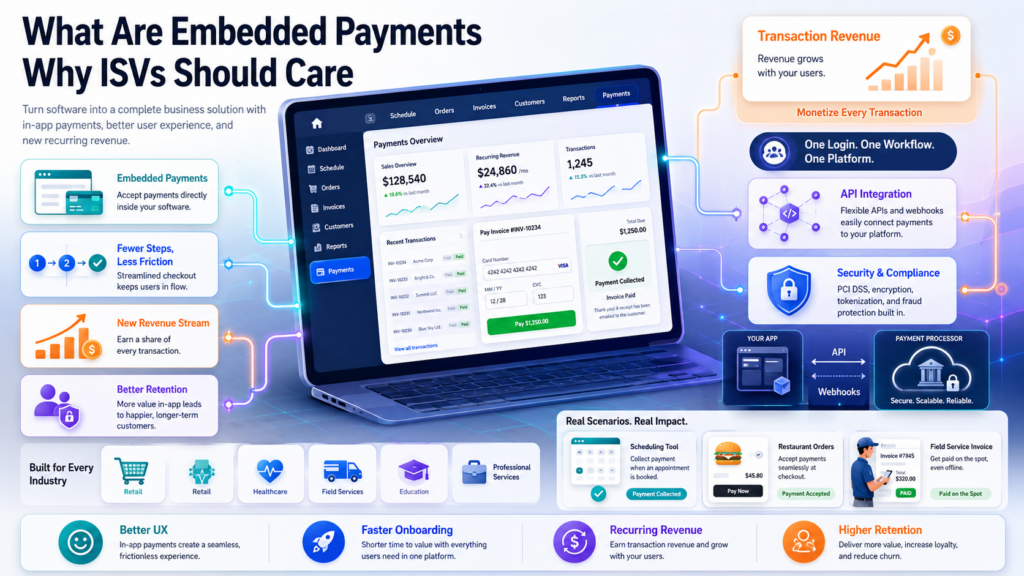
Understanding Embedded Payments
Embedded payments involve embedding payment functionality directly within the software application. Rather than sending customers to a different payment provider’s site, the payment transaction takes place directly within the software application itself.
It is critical for Independent Software Vendors (ISVs) and Software-as-a-Service (SaaS) applications catering to sectors such as retail, healthcare, field services, education, and professional services.
Simply put, embedded payments transform software from a mere operational management tool into a fully-fledged business solution.
Why Embedded Payments Are Growing
Today’s businesses do not want more tools and multiple logins; what they need is friction-free processes. Embedded payment solutions ensure this through integrated operations and payments management from within the business process itself.
A scheduling tool, for instance, can help users manage scheduling and payments together. Order-taking software used by restaurants can manage order processing, payments, and reporting without having to switch to different tools. A field service management tool can create an invoice and get paid on the spot.
This is how embedded payments work.
The Opportunity for ISVs
Embedded payments are no longer just a feature but also a huge revenue generator for ISVs.
Through the inclusion of payment features, software firms can tap into a piece of the action in each transaction, as opposed to depending solely on subscriptions. This allows them to diversify and secure an income stream that grows with their clients.
Furthermore, embedded payments increase client retention rates since it would be difficult for users to switch once payments have been integrated into their systems.
Improving User Experience and Reducing Friction
Embedded payments make life easier for customers because they involve fewer steps in the payment process. Users don’t have to integrate any third-party payment providers and use additional billing applications.
All is done through the software itself, resulting in quick onboarding and technical ease.
It is particularly helpful for smaller and mid-sized companies that seek one-stop-shop products rather than dealing with different vendors.
How Embedded Payments Work Behind the Scenes
In the backend process, the payment system integrates the software platform with the payment processor using the application programming interface (API). This means that the ISV works in collaboration with the payment provider, who ensures compliance and takes care of security and transaction processing.
The Bottom Line
The use of embedded payments is increasingly becoming an industry norm for software platforms today. For ISVs, the integration of payments offers an opportunity to enhance their products and grow their revenues.
Through the embedding of payments within their platforms, software companies can improve customer satisfaction, retain customers, and generate additional revenues from them.