
What Omnichannel Payments Really Mean
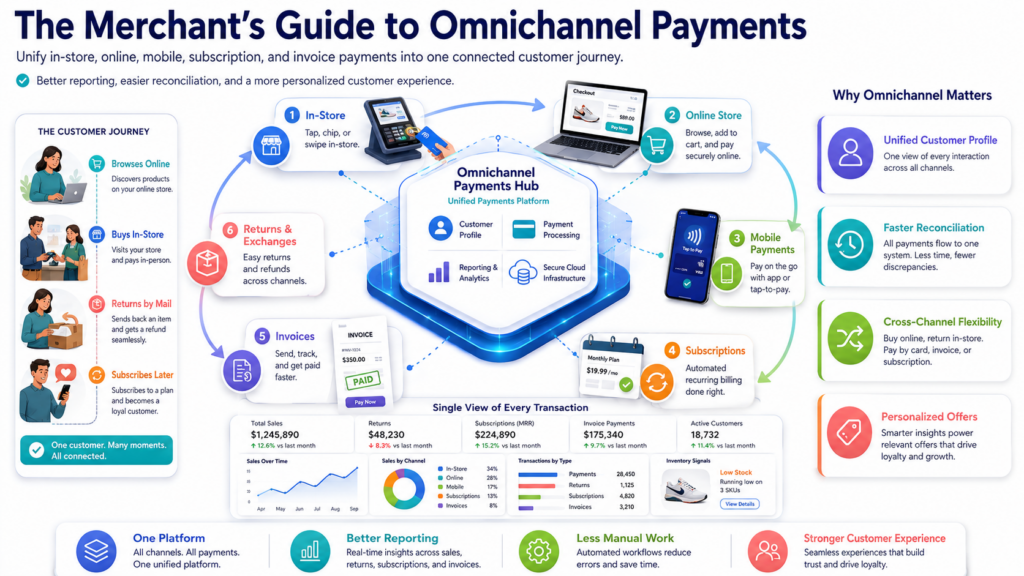
An omnichannel payment system involves the seamless integration of payment services from every point at which a consumer interacts with the merchant.
While traditional approaches focus on managing different sales channels individually, an omnichannel payment system links all of them together. Consequently, an omnichannel payment service benefits both consumers and merchants.
In the contemporary business environment, omnichannel payments are no longer an add-on but rather a standard practice.
Why Omnichannel Matters for Merchants
The customer does not see through any particular channel. The customer may look at a product on the website, purchase it in person, return it via mail, and even subscribe to the service later.
By having such activities carried out using different systems, problems arise. Businesses will be forced to have fragmented information, a non-uniform profile of customers, and more manual reconciliations.
This problem can be solved using omnichannel payments.
Unifying In-Store and Online Payments
One of the main advantages of omnichannel solutions is the ability to connect physical and online sales channels. For instance, a consumer who purchases in-store will get relevant online offers at a later stage. In case of returns made online, such returns can easily be handled in-store without any hassle. This helps in providing uniformity to consumers and employees alike.
Mobile, Subscription, and Invoice Payments
The omnichannel solution goes beyond the conventional retail channel.
Mobile payments enable customers to make purchases via an app or through tap and pay mechanisms. Billing using subscription models ensures continuity of recurring revenue. Invoicing makes payment acceptance and tracking easier for service organizations.
A combination of all these brings visibility to the entire financial picture.
Better Reporting and Reconciliation
Simplification of reconciliation is one of the most important operational benefits of omnichannel payments.
There is no need to retrieve information from various systems, but merchants can access all transactions at once, which results in minimizing possible mistakes and saving money and time.
Personalization and Customer Experience
Businesses can have a good idea about their customers’ likes and purchase patterns if there is one source for all transactions.
It becomes easy to reward their customers with personalized incentives and promotions based on their purchase behavior.
The Bottom Line
While omni-channel payments refer to accepting payments from any location, they encompass much more than that. It is about integrating all interactions that customers have in their journey into a single platform.
From a merchant perspective, it offers improved data, operational efficiency, and a unified customer experience across channels. As consumer demands continue to increase, omni-channel payment solutions are becoming increasingly important.