
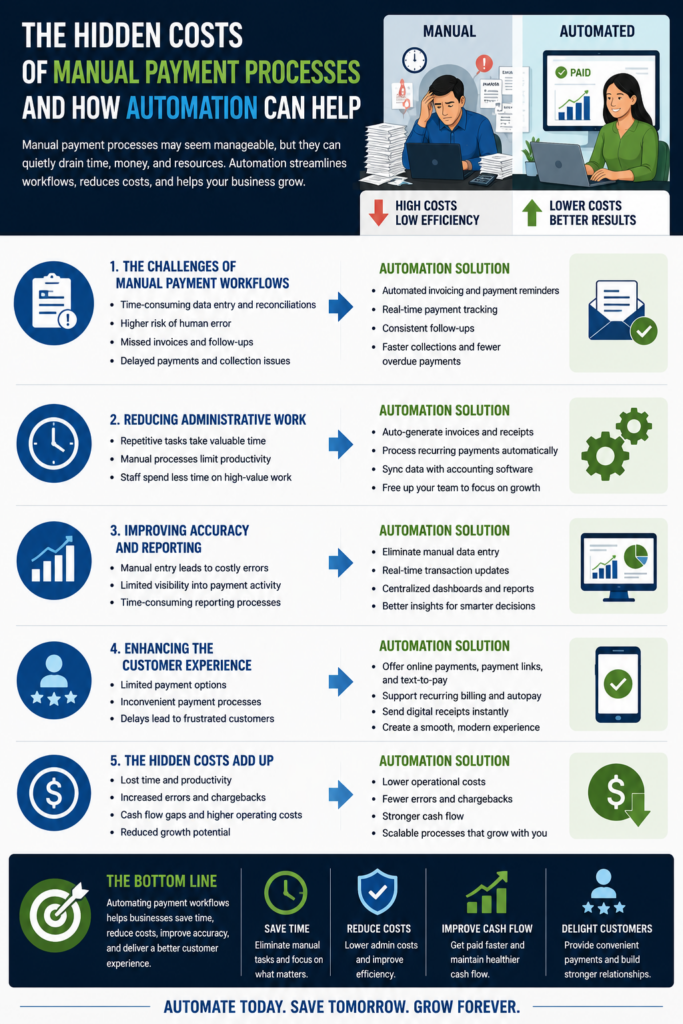
Manual Payment Processes Are More Expensive Than They Appear
Most companies look at fees for transaction processing when considering their costs, while the cost related to manual payment processing is usually not taken into consideration. The creation of invoices, receipt of money, accounting for arrears, reconciliation of receipts and refund processing are activities that take considerable time and efforts.
These processes may appear to be simple enough, but they might have an impact on company performance.
The Challenges of Manual Payment Workflows
Manually making payments means that employees have to enter information, give out reminders, make payments and then update all records in various systems. It wastes both time and increases the risk of errors.
Human mistakes may range from entering double information, wrong amount of money to be paid, missing invoices and reconciliation mistakes. Companies can face the problem of late payments due to manual collection procedure.
How Automation Improves Cash Flow
Automating payments facilitates businesses to collect their payments quickly by automating the entire process. Invoice payment, recurring billing, reminders, and electronic payments will prompt customers to make payments.
There is no need for businesses to follow up on any unpaid invoice manually since there are ways of automating the process through reminders and notifications.
In most cases, quick payment improves cash flow.
Reducing Administrative Work
Automation can drastically cut the time taken by the staff in repetitive payment-related duties.
Payment solutions today can automate invoice generation, transaction processing, receipt issuance, customer data maintenance, and synchronization with accounting applications. This will give the staff more time to concentrate on other things that add value.
Improving Accuracy and Reporting
The automated payment process system will be helpful in minimizing errors since there is no need for manually entering any information and real-time monitoring of the transactions. In most cases, there is a reporting dashboard that will assist in tracking sales, returns, chargebacks, deposits, and payments made by the customers.
Enhancing the Customer Experience
Payment convenience is what customers are beginning to expect from businesses today. Automated payment systems can offer online payments, payment links, recurring payments, text-based payments, and digital invoices.
This would make the customer experience much better while eliminating any delay in payment.
The Bottom Line
Even though manual payments may appear to be cost-efficient, the costs associated with inefficiencies, mistakes, late payments, and administrative work might turn out to be quite substantial.
With the help of payment automation, companies are able to optimize their cash flow, cut expenses, increase precision, and offer customers more comfortable services. The more businesses develop, the more they can benefit from using payment automation technology.