
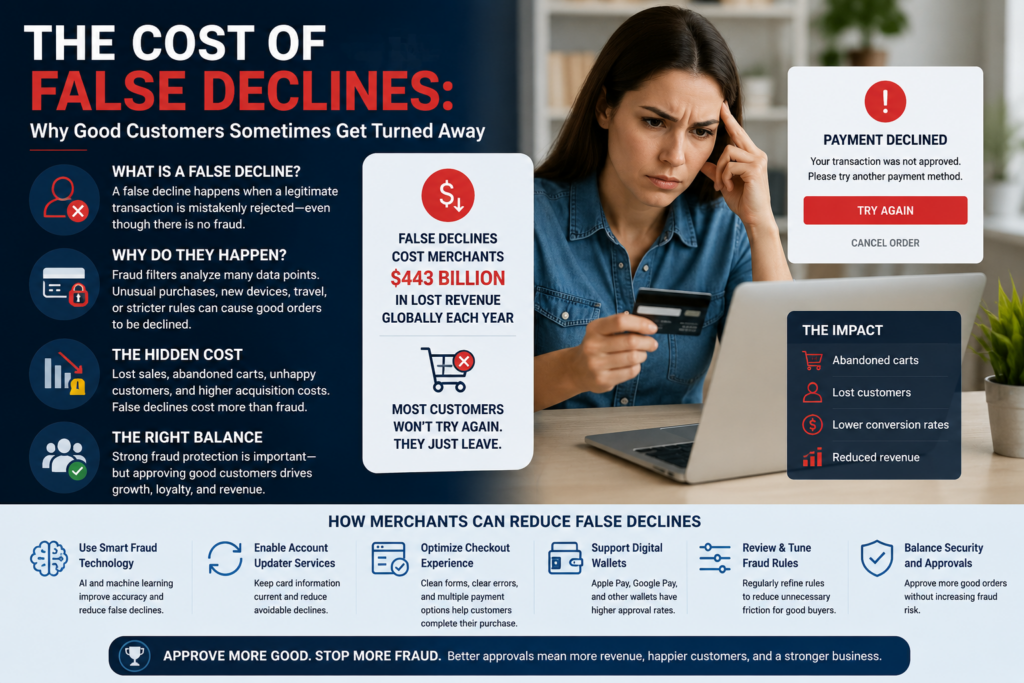
What Is a False Decline?
The majority of merchants concentrate on avoiding fraud, however, there is another issue concerning payments that is usually overlooked – false declines.
False decline is an erroneous rejection of a legitimate payment attempt made by a payment processing service or an issuer of a card. In simple words, it means that a real customer uses his real card in order to pay for goods or services but faces a transaction rejection.
Although it is essential to avoid any frauds, it may prove to be very costly for merchants.
Why Do False Declines Happen?
Financial institutions and payment facilitators make use of advanced fraud detection techniques to detect any suspicious activities related to transactions. These systems consider various aspects like spending habits, device data, location, transaction amount, and transaction history.
Sometimes, these measures work very effectively. For instance, if a consumer makes a large purchase, buys when traveling, uses a different device, or purchases from an unknown merchant, then he/she might have to face rejection of a valid transaction.
False declines are also caused due to old card information, wrong billing information, or fraud prevention system that works very aggressively.
The Hidden Cost to Businesses
Not only does the merchant miss out on making a sale when a legitimate transaction is declined, but most often, the customer will not even try to make the purchase again.
The impact on an e-commerce business is not only in loss of income, but also in reduced conversion rate and increased customer acquisition cost. This issue is especially critical when it happens to loyal customers who have had several problems with payments and lost faith in the checkout system.
Industry researches prove that merchants often lose more money due to false declines than because of fraud.
How Merchants Can Reduce False Declines
Modern payment solutions can facilitate the process of increasing the acceptance rate of orders without compromising on security. There are many modern fraud detection tools that utilize machine learning and artificial intelligence to distinguish fraudulent activity from genuine customers’ requests.
Other ways of doing this include the activation of account updater features, optimized checkout forms, using digital wallets, and frequent review of fraud rules.
Finding the Right Balance
A good anti-fraud system is all about finding a balance. A business should be able to prevent fraud without blocking valid customers.
The point is not just blocking more transactions; the point is approving as many legitimate transactions as possible and preventing any actual fraud. Companies who achieve this are usually able to increase their conversion rates, their customer satisfaction levels, and their profits.
Final Thoughts
Each decline is a potential loss for the merchant. It is necessary not only to focus on protecting from fraud, but also to analyze approval rates and customer experience.
The optimization of approval rates allows increasing sales while providing good customer experience.