
What Is PCI DSS?
Payment security may be intimidating to many small business owners, particularly when there are specific technological considerations to be met. The most crucial thing that businesses must become familiar with regarding payment security is PCI DSS, which is an acronym for Payment Card Industry Data Security Standard.
PCI DSS is a collection of security standards intended to help businesses ensure that their cardholder data is secure while conducting payment transactions. It covers all those businesses where there are card transactions either through face-to-face, eCommerce, or wireless payments.
The current standard known as PCI DSS 4.0 has been designed to accommodate recent developments in payment security standards.
Why PCI DSS 4.0 Matters
With the advancement of payment technology come new opportunities for fraudulent activity as well as new vulnerabilities in the protection of customer payment data.
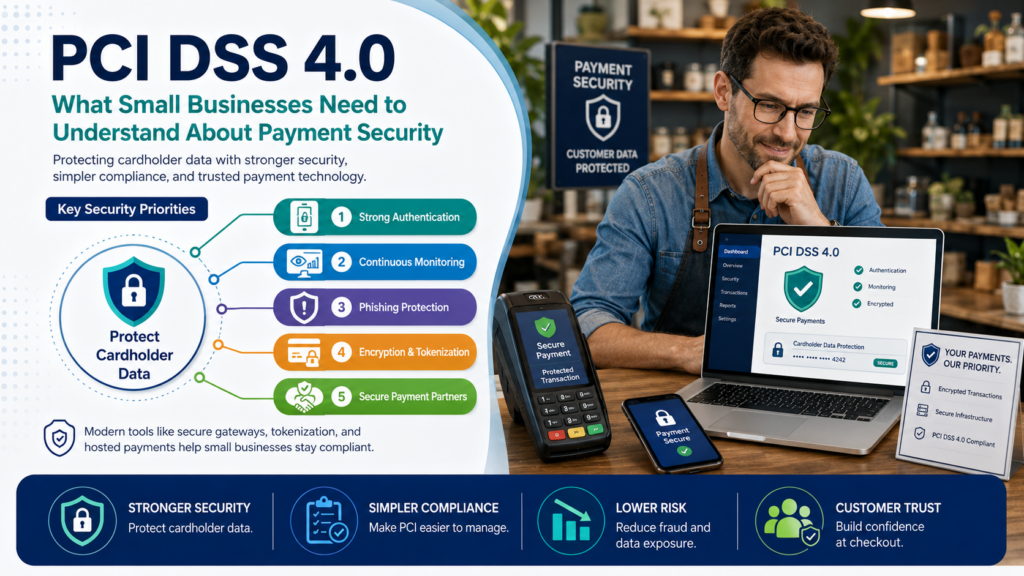
The PCI DSS 4.0 standard is designed to increase flexibility while ensuring enhanced safeguards against threats to customer payment information. These include, among others, improvements such as robust authentication methods, continuous monitoring of cybersecurity measures, and safeguarding against phishing attacks. Small business owners should not view PCI compliance as a mandatory measure that may lead to fines but rather as an essential part of doing business.
Compliance Does Not Have to Be Intimidating
Small business owners believe PCI compliance is a problem faced by big companies alone. Small businesses tend to be attacked due to the weakness in their security system.
However, there is no need for complex technology or in-house IT staff when becoming PCI compliant. Most merchants and payment processors now include their security measures, which make PCI DSS compliance requirements much simpler.
Encryption, tokenization, payment gateway security, and fraud detection are among the key features that help businesses stay safe and easy on their way to PCI compliance.
How Merchant Service Providers Can Help
A trustworthy merchant service provider can help businesses in their security and compliance efforts significantly. Most of the service providers provide PCI-compliance services, compliance assistance, secure hardware, and other services that can assist businesses in minimizing their handling of sensitive credit card information.
For instance, by leveraging the use of hosted payment pages and cloud-based systems, businesses can minimize their exposure to sensitive card data, thus reducing their compliance obligations.
This becomes particularly critical for businesses that operate via multiple sales channels, including their brick-and-mortar retail stores, online e-commerce sites, and mobile payment systems.
The Bottom Line
The purpose of PCI DSS 4.0 might seem complex, but it is relatively simple: ensuring the safety of the payment data and minimizing security threats for companies and their customers.
It has become especially relevant for small businesses to remain PCI DSS 4.0 compliant as the number of digital transactions continues to rise. Collaboration with payment service providers and the use of payment technologies will enable small businesses to improve their security posture and make the process easier to handle.