
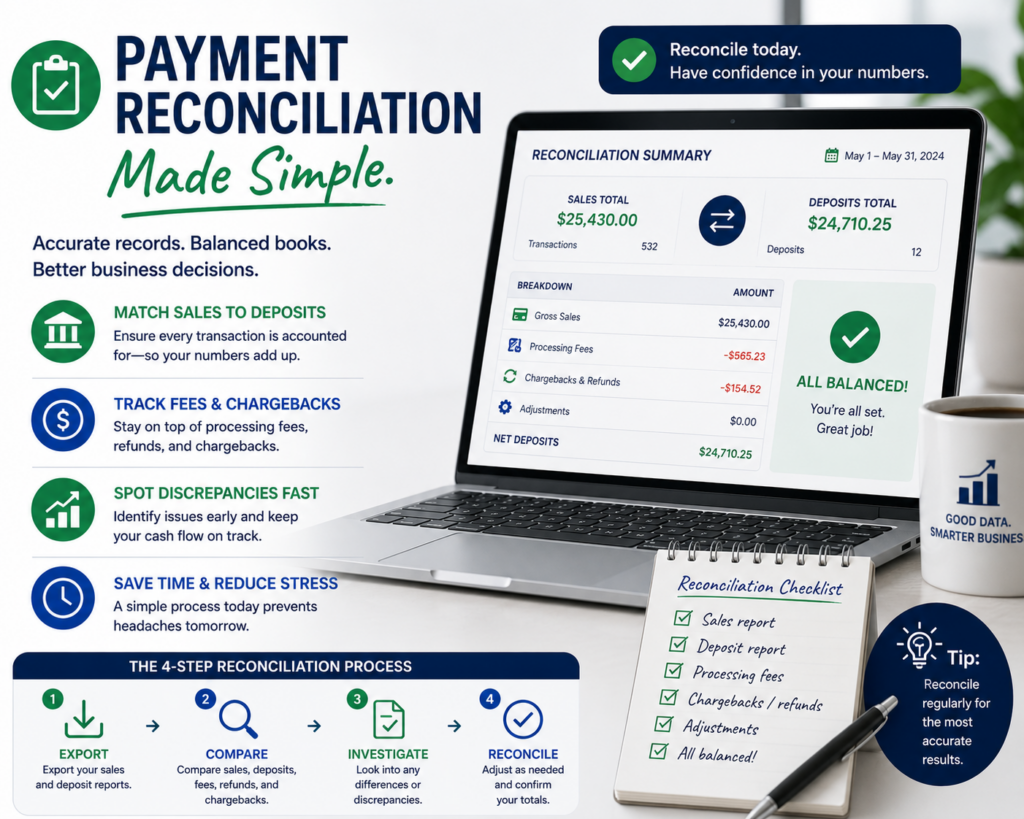
For most companies, receiving payments may not be difficult. The difficult part comes when there is a need to reconcile payments with deposits into banks, processing charges, refunds, and reversals. Poorly coordinated reconciliation activities cause accountants to waste much time looking for inconsistencies and matching data.
Effective coordination of payment reconciliation activities helps companies keep accurate accounts.
What Is Payment Reconciliation?
Reconciliation of payment means comparing payment transactions with money that finally goes into your bank account.
On the surface, this task does not look complex. The truth, however, is that the amount you deposit will not always be equal to the total sales made on a certain day.
This could include various aspects like fees for processing, refunds, reversals, gratuities, and deferred settlements among others.
Why Reconciliation Gets Complicated
Most businesses use many different types of payment methods, such as point of sale (POS), ecommerce sites, mobile payments, invoicing, and subscription billing software.
Each method of payment will often have its own unique reporting processes and terms of settling transactions. With an increase in the number of transactions, manual reconciliation becomes more cumbersome.
Even minor errors can cause much confusion and investigation.
Common Reconciliation Challenges
The common problem is to understand why there is no balance between the deposit made by the bank and the amount of sale for the same period. In some cases, fees may have been deducted from the total sale amount before being deposited in the bank account.
Other problems include refunds and chargeback since these transactions usually take place after some time after the initial transaction took place. Companies using various payment processors for the processing of their payment transactions may find it difficult to report on this issue.
How Technology Can Help
The modern payment solutions provide tools for automatic transaction, deposit, fee, and adjustment reconciliation.
Integration between a payment solution and accounting software can decrease manual work and increase accuracy. Companies using automation tools usually spend more time analyzing their performance rather than reconciling transactions.
The Bottom Line
It’s an integral part of finance management, but it doesn’t have to be a tedious process. With adequate knowledge about payments flows within your organization, together with the use of the appropriate reporting tool, payment reconciliation could help make everything smoother.
It not only ensures accurate records, but also gives business owners some level of assurance regarding their finances.