
What Payment Orchestration Actually Means
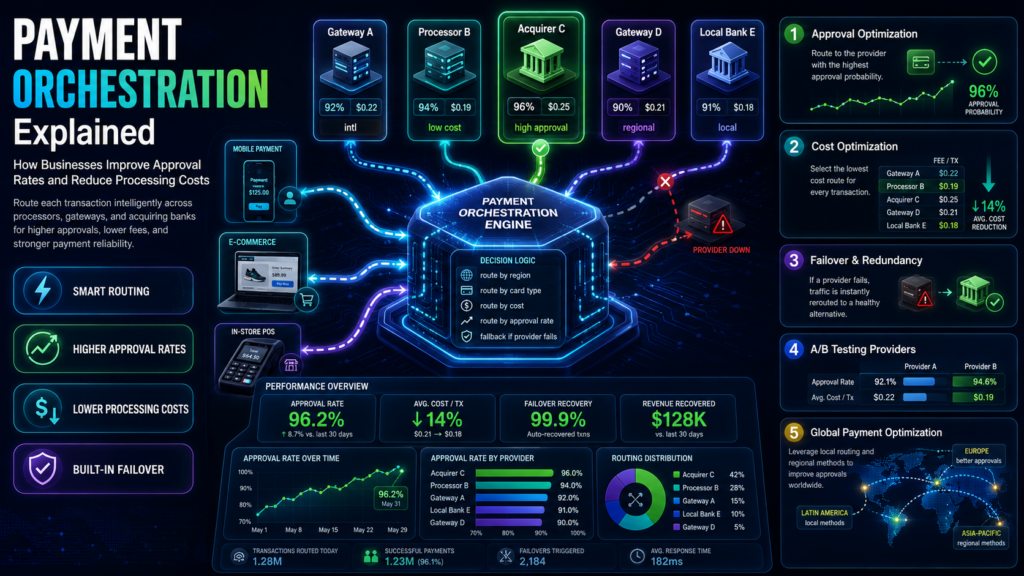
While payment orchestration may seem like a complicated concept, the essence of its working can be explained quite easily. While traditionally, payments are routed through just one payment processor, with this technology, businesses are able to route payments intelligently via several different processors, gateways, and acquiring banks.
You could think of payment orchestration as the level of control where decisions are made on how to route each transaction to ensure the highest approval rate, cost efficiency, and stability of payments.
Why Businesses Are Moving Beyond a Single Provider
Dependence on only one payment processor comes with several challenges. For example, if the payment processor has higher rejection rates for specific credit cards, areas, or amount sizes, then the company will lose money.
There is also an element of risk because in case the payment processor has any downtime, there won’t be payment processing at all.
This problem is solved through payment orchestration.
Smart Routing for Better Approval Rates
A major advantage associated with payment orchestration includes intelligent routing. Here, payments are automatically routed through a provider whose success rates are high in authorizing that specific transaction.
For instance, if a payment comes from an international customer, then it will be routed through an international gateway. However, when a local transaction is made, then a cheaper provider will process the payment.
Reducing Costs Through Optimization
Processing fees may differ based on the payment processing provider, location, and the type of transaction. Orchestration platforms enable merchants to lower their costs through effective routing of payments in the least expensive route possible whenever possible.
In the long run, small savings on each transaction will accumulate into large sums.
Failover and System Redundancy
Another big advantage is the automatic rerouting of transactions in case one processor faces problems such as downtime or high declines.
This way, failed transactions can be minimized and customer satisfaction maximized by allowing them to make payments regardless of any issues faced by processors.
A/B Testing Payment Providers
Payment orchestration can even facilitate A/B testing for different processors. Companies can monitor the performance, fees, and acceptance rates in real time to see which processor is better.
This ensures that the companies do not make decisions based on assumptions and old contracts but base their optimization decisions on actual data.
Global Payment Optimization
Payment orchestration plays an important role for companies that work in several countries. Various parts of the world have different preferences in payments and approval procedures.
Orchestration helps businesses direct payments on a regional basis, increasing approval levels internationally while accommodating various payment solutions.
The Bottom Line
The payment orchestration approach will provide greater flexibility to businesses as far as processing payments is concerned. Instead of depending on a single supplier, merchants can tune each transaction for better efficiency and reliability. For growing organizations, it means something else as well. It means doing things right, maximizing the revenue generated from transactions.