
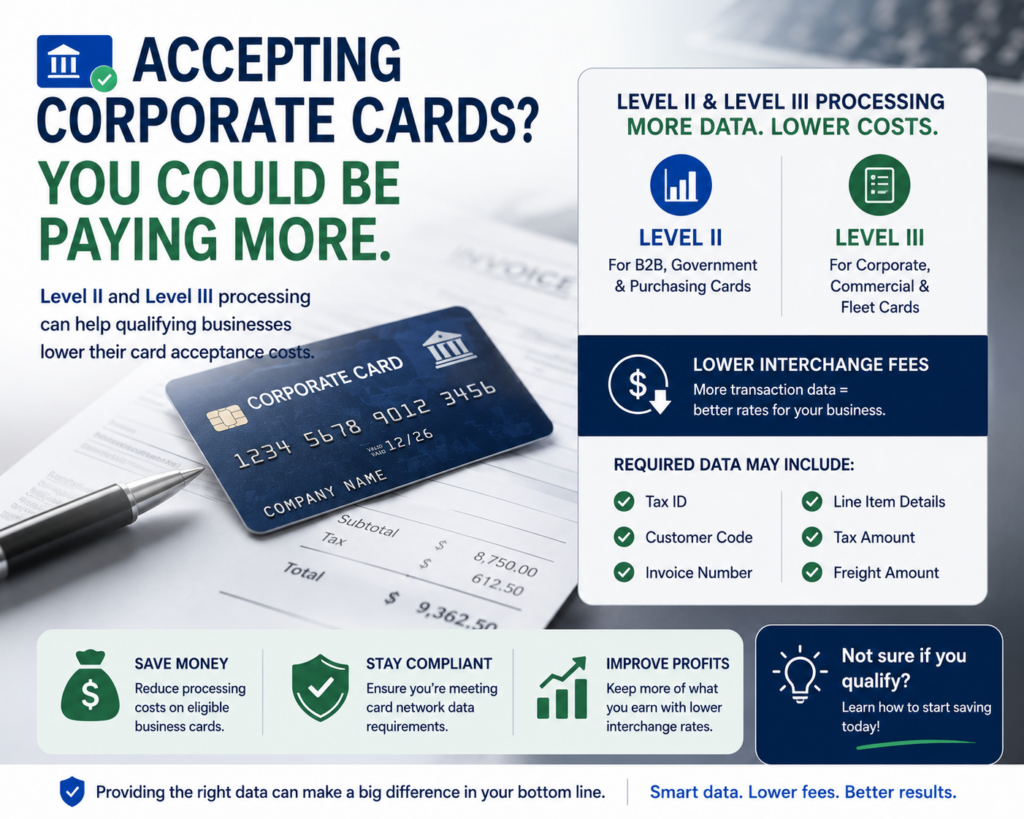
In many cases, credit card processing costs are simply considered overheads of running a business. Nevertheless, businesses that do business with each other or even with organizations from the government sector can take advantage of their situation and try to cut down their expenses using Level II and Level III processing services.
It must be noted that Level II and Level III services do not apply to all transactions but can help achieve lower interchange rates on certain occasions.
What Are Level II and Level III Transactions?
The credit card transaction is placed under various categories depending on the information provided during the transaction process.
Level I involves minimal information about the transaction including the credit card number, transaction amount, and merchant information.
Level II and Level III involve extra information to help card processors make an assessment and monitoring of the business transaction made. The more information provided, the lesser the risk assumed by card processors.
Which Businesses Benefit Most?
Level II and Level III processing is intended mainly for business establishments which accept commercial, corporate, purchasing, and government cards. In most cases, those organizations which sell their goods or services to another corporation stand to gain the most from the program.
Examples of organizations which may need Level II or Level III processing include manufacturers, wholesalers, distributors, government contractors, healthcare organizations, and technology firms. The potential savings from lowered interchange fees can be significant in these industries.
What Additional Information Is Required?
The requirements for merchants to achieve Level II or Level III rates involve providing more transaction details compared to those needed for regular consumer transactions through credit cards.
Transactions falling under Level II involve transaction details such as taxes, invoice numbers, and customer codes, while Level III transactions require transaction details like the description of the item, quantity, cost per unit, shipping costs, among others.
Additional transaction details help card issuers determine the intended use of the transaction and receive favorable interchange rates.
The Importance of Payment Technology
However, all payment systems do not offer capabilities to process Level II or Level III transactions. In most cases, the merchant will require a payment gateway, integration with their ERP system, virtual terminal services, or a payment platform to automatically collect and send the necessary information.
Dealing with a payment service provider who is knowledgeable about B2B transactions would be helpful since they would be able to correctly process your payments.
The Bottom Line
If you accept business, procurement, or government cards for payments on a regular basis, level II and level III payment processing can offer an excellent chance to save on payment acceptance expenses. With the added information about transactions provided, the chances of obtaining low interchange fees increase significantly.
Level II and Level III payment processing can be considered one of the most efficient means to cut costs for B2B companies.