
Understanding the Two Approaches
Organizations have two options when it comes to selecting the payment method: standalone terminals and integrated payments. These methods accept both credit and debit cards, yet function quite differently.
Standalone terminals are regular card terminals that do not connect with any other organizational system. Integrated payments are part of POS systems, ecommerce systems, invoicing systems, ERP systems, or other applications.
Choosing the appropriate solution depends on the nature of the organization.
What Are Standalone Payment Terminals?
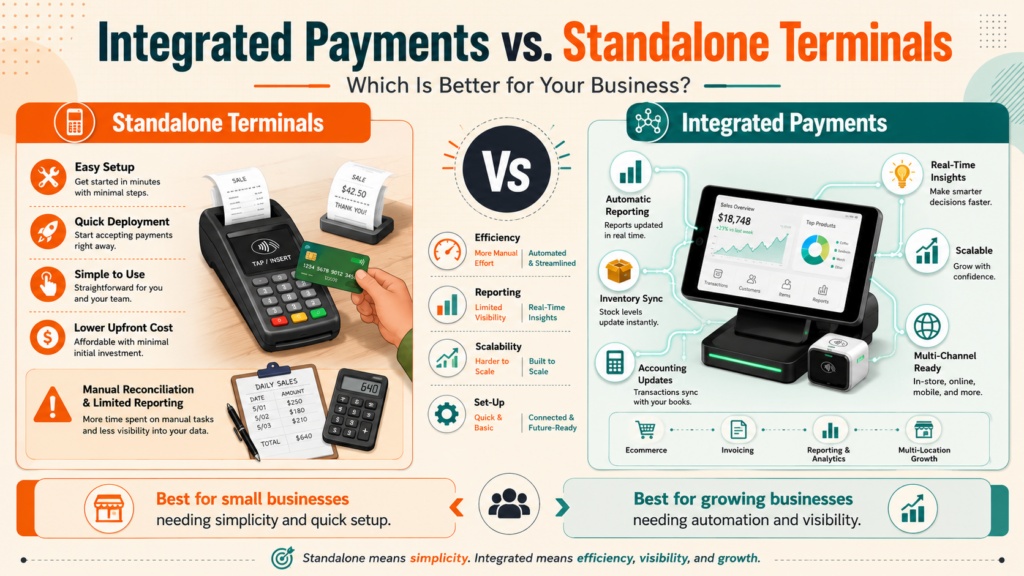
Standalone terminals include the card terminal devices found at cash registers. Customers use the machine to scan, insert, or touch their cards, and the transaction gets processed alone.
These types of terminals are easy to use, quick to deploy, and dependable. Small businesses who wish to have straightforward payment processing without any hassles typically utilize them.
On the other hand, they may need manual reconciliation since sales data recording and inventory management get done independently, leading to increased errors and effort.
What Are Integrated Payment Systems?
The integrated payments are integrated directly within the business software. These may include point-of-sale software, ecommerce software, invoicing software, enterprise resource planning (ERP) software, and software as a service (SaaS).
Upon making a payment, the transaction information automatically updates the inventory system, accounting system, and reporting system.
This streamlines processes and increases visibility in the organization, particularly when there are many transactions or multiple branches.
Key Differences:
- Efficiency
Integrated systems automatically produce reports and record transactions. Standalone devices require manual data recording and balancing.
- Reporting
Integrated payment solutions offer real-time analysis for sales, returns, and stock management. There is limited reporting functionality available with standalone devices.
- Scalability
Integrated payment solutions can be scaled to accommodate multiple stores and sales channels. Standalone devices can be utilized in small, one-time projects.
- Set-up
Single payment devices are easy to set up. Payment integration solutions require some installation, but they offer a lot of operational benefits compared to the former.
Which Option Is Better?
Independent terminals suit those small businesses requiring ease of use, less expense, and quick installation with little training.
An integrated payments system is more suited to growing businesses where automated processing and improved analytics are desired.
The Bottom Line
Independent terminals emphasize ease and quickness initially. Integrated payment systems emphasize efficiency, information availability, and scalability. As a business grows and transactions become more frequent, companies will typically shift towards using an integrated system for these reasons.