
Why You Should Review Your Merchant Processing Statement Every Month
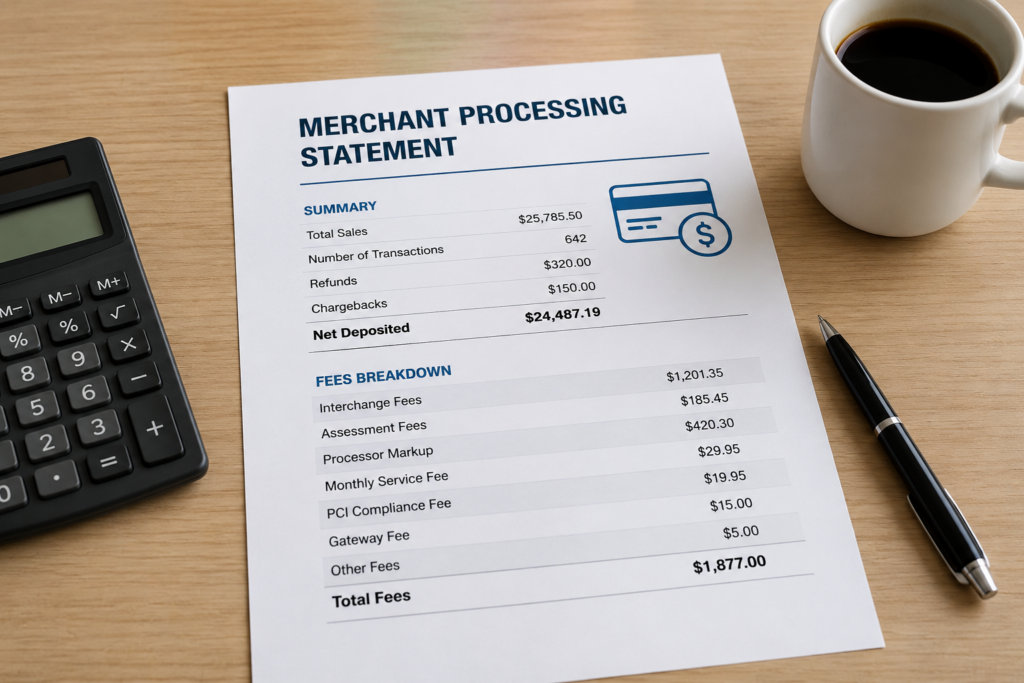
The merchant processing statement will tell you the whole story about payments in your business. It tells you how much money has been processed by you, the fees that have been incurred in the process, and the money that has been deposited into your bank account. However, many business owners fail to get past the total deduction amount.
It’s no wonder why. Many times, merchant processing statements are riddled with technical words and payment jargon that may prove hard to understand. The good news is that you don’t have to be an expert in payment processing to be able to interpret a merchant processing statement. There are a number of sections that you could familiarize yourself with and save yourself from some billing issues.
What Information Is Included on a Processing Statement?
Although each processor provides their statements in different ways, the basic details remain the same for all statements.
You would find your total sales amount, credit card transactions, refunds, chargebacks, and the amount that has been transferred to your bank account. In addition to this, there will be an overview of the fees you have to pay as part of your processing expenses.
There are certain fees that are fixed, such as interchange fees and card brand fees, that are determined by Visa, Mastercard, Discover, and American Express. Other fees are levied by your payment processor and may consist of monthly fees, PCI compliance fees, payment gateway fees, equipment fees, or processor markup.
Understanding what fees are fixed and which one is determined by your service provider becomes easy then.
Verify That Your Deposits Match Your Sales
The most important part of your merchant processing statement is the funding detail. In this part, you compare the total of all your sales to how much has been credited to your business account.
It will come as no surprise when you find these two figures are not always the same. There may be various deductions that have been made to your sales before depositing them.
It will provide you with peace of mind that everything has been deposited accurately.
Watch for Fees That Don’t Belong
Comparing your processing statement to prior months is a good way to keep tabs on things. Should you find new monthly fees, higher rates, or unfamiliar services, you should contact your payment processor to find out more.
Not all pricing changes will be for real, and in some cases, you might even come across unnecessary services that you could have your payment processor eliminate.