
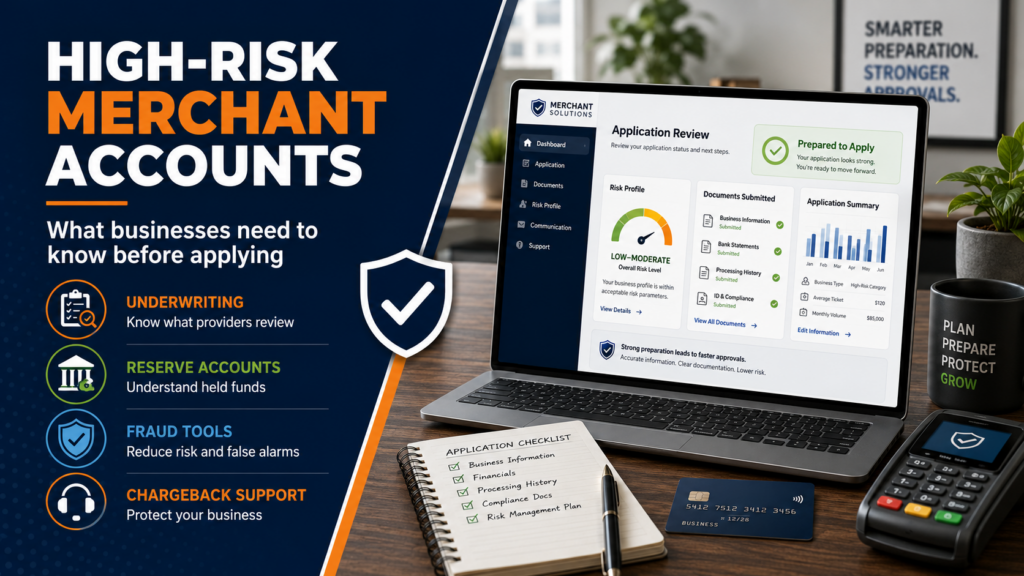
It might be concerning to hear that your company falls into the category of “high-risk.” However, within the payments world, that does not necessarily mean that there is anything wrong with your business. Typically, it means that your industry, business model, or transactions are more financially risky than others.
There are a lot of profitable companies that run successfully as high-risk merchants. The thing is to know what the whole application process entails.
Why Some Businesses Are Considered High Risk
Some industries have an inherently higher incidence of chargebacks, refund requests, fraudulent transactions, and customer complaints than others. For that reason, some payment processors and banks will identify those industries as high-risk.
Some examples of such high-risk industries are the travel industry, subscription-based firms, online coaching businesses, nutraceutical products, CBD oil, eCommerce, games, and international business.
In addition, companies can also be designated as high-risk due to such features as high transaction volumes, larger ticket sizes, recurring payments, and limited history of processing transactions. Even young businesses without any negative track record may qualify as high-risk because there are not enough data points for banks to analyze.
What Happens During Underwriting
During the application for merchant accounts, companies have to go through a procedure known as underwriting, where the processor and acquiring banks assess the financial stability and risks involved.
Merchant account providers may request details such as bank statements, transaction history, identification, marketing literature, or product/service details from the business owner. Although this might seem like an overload of documentation, it is necessary so that the provider gets a clear picture of how the business works.
High-risk accounts will take longer to be approved compared to regular merchant accounts.
Understanding Fees and Reserve Accounts
Merchant accounts considered high risk usually carry higher fees since there is more risk involved for the payment processor. Some merchants might even need to have reserve accounts.
Reserve accounts refer to a portion of sales that will be retained by the processor to act as a buffer in case of disputes in the future. Although having a reserve might cause some short-term financial problems, this is quite common for high-risk businesses and might change after establishing a good processing history.
How to Improve Your Chances of Approval
These include establishing refund policies, providing correct billing descriptions, offering good customer service, and keeping proper financial documentation.
Chargeback reductions and steady sales activity can also be effective in building a stronger risk profile.
Choosing the Right Payment Partner
However, not all payment processors have a complete understanding of the high-risk industries. Having an effective relationship with a payment processor who specializes in the field can be an advantage.
An ideal payment processor can assist companies in preventing fraud cases, lowering chargebacks, stabilizing accounts, and handling payments smoothly without interruptions. To growing firms, such assistance could be as important as the actual transaction processing services.