
The Payments Industry Is Evolving Rapidly
How payments are made is transforming more quickly now than at any other time. New technology, shifting customer expectations, and novel financial innovations are all contributing to the transformation of payments. Companies that are aware of and can keep up with these transformations will fare well when competing and growing.
There are many different things that can happen in the future, but there are a number of trends that will affect payments until the year 2030.
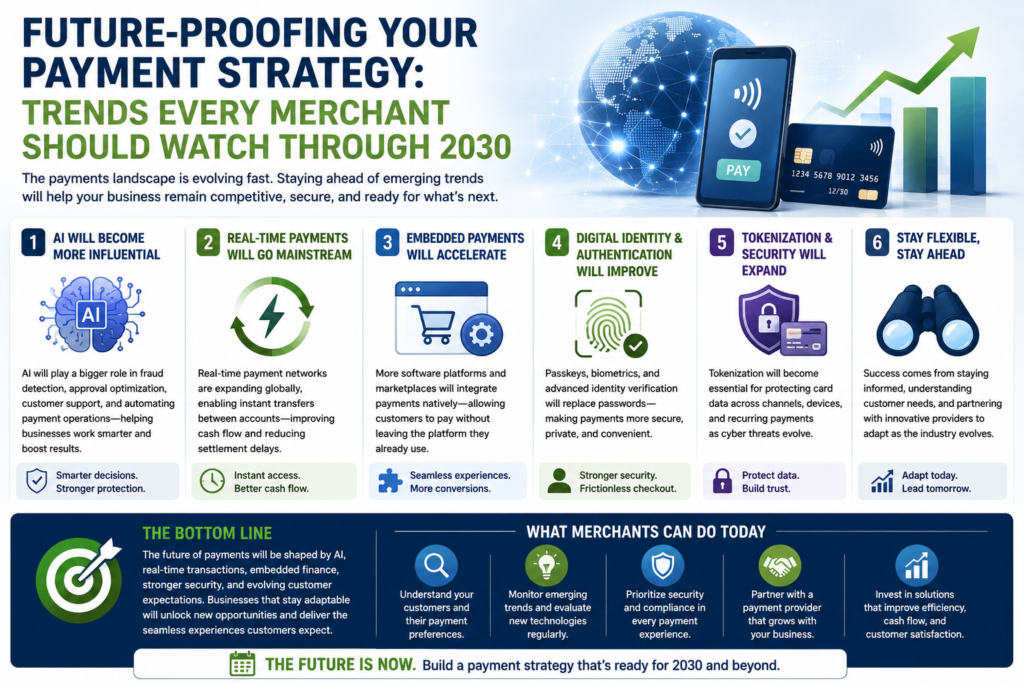
Artificial Intelligence Will Become More Influential
The benefits that artificial intelligence offers to organizations include detecting fraud, enhancing customer service, and automating operations. In the coming years, artificial intelligence will be even more significant in the processing of payments.
AI-driven tools could enable merchants to optimize approval rates, personalize the checkout experience, find operational inefficiencies, and prevent fraud while avoiding unnecessary friction.
Real-Time Payments Will Become More Common
Businesses and customers are now expecting instant liquidity. Faster payment systems are now spreading around the world, and transactions can take place between accounts within seconds and not days.
Fast payment is helpful for cash flow management, eliminating delays, and generating chances for businesses that require liquidity instantly.
Embedded Payments Will Continue to Grow
Increasingly more software platforms are embedding payment capabilities within their offerings. Known as “embedded payments,” this capability enables customers to conduct payments without having to exit the software they use.
Businesses can expect to see more payment experiences embedded within specialized software, marketplaces, and business platforms.
Digital Identity and Authentication Will Improve
Password authentication systems are increasingly giving way to other security techniques. Passkey, biometric technology, and other identity verification processes are likely to become more prevalent.
Such technologies may assist in enhancing security while providing a faster checkout experience.
Tokenization and Security Will Expand
With the continuing rise in cyberattacks, safeguarding payment data would always be an important aspect. In place of card data, secure tokens would be used through tokenization, decreasing the chances of data leakage.
Tokenization is likely to increase in importance, especially when considering omnichannel payments, recurring billing, and stored payment credentials.
Preparing for the Future
It is unlikely that the most successful businesses will use all new forms of payment. Rather, they will learn about the customers’ preferences, increase their efficiency and flexibility to change.
Thanks to observing emerging trends and collaboration with payment partners, merchants can develop a payment strategy that will remain competitive throughout 2030 and later years.
The Bottom Line
Artificial intelligence, real time payments, embedded finance, increased security, and changing customer expectations are going to shape the future of payments.
The organizations which stay adaptable and forward thinking will definitely benefit from these changes by making use of the available opportunities and by offering what customers want.