
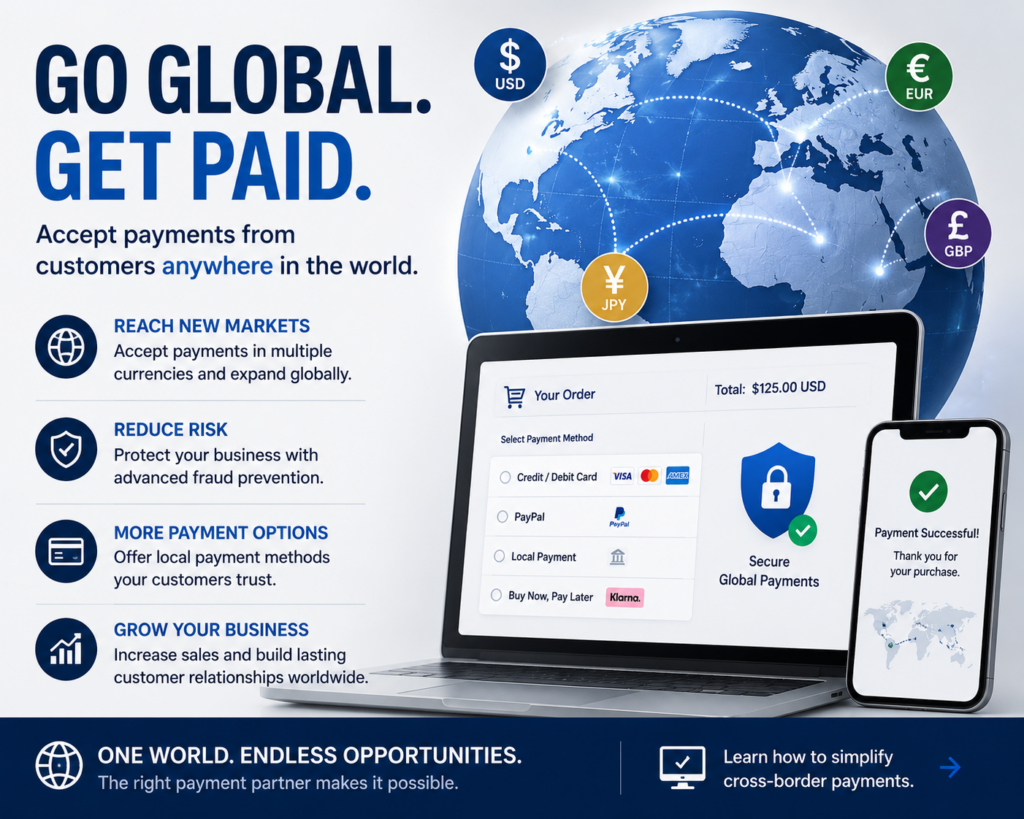
Entering the international market can present lucrative business prospects for e-commerce businesses. As a result of the advent of online marketplaces, logistics services, and digital marketing channels, the process of selling products internationally is now more accessible than ever. Nevertheless, one cannot ignore the challenges posed by international payment acceptance.
Why Cross-Border Payments Matter
Consumers today anticipate buying products from companies operating out of any place in the globe. Often, the process of payment becomes the reason why a consumer will end up buying a product or dropping it from their shopping cart.
Having an efficient cross-border payment method allows merchants to convert more customers into sales and build customer trust.
Offer Local Currency Pricing
One of the easiest methods to boost sales internationally is by enabling users to see prices in their local currency.
In cases where they must compute exchange rates themselves, there may be uncertainties and unfavorable rates. When you allow local currency pricing, buyers will get a clear view of the amount that will be charged to them.
Several payment systems have developed dynamic currency conversion and multi-currency checkout features.
Support Local Payment Preferences
Credit card payment is widely used across the world, although this form of payment is not preferred in some countries.
Based on the area, there may be customers who prefer other payment forms such as bank transfers, digital wallets, real-time payments, etc. Limiting yourself to credit cards may limit your ability to conduct transactions overseas.
Understand Foreign Exchange Costs
International transactions will include currency exchanges and currency transaction fees. This will be true for both the business and the consumer.
It is imperative that businesses select a payment partner that offers competitive exchange rates. Otherwise, businesses could lose money through currency conversion.
Prepare for Increased Fraud Risk
Cross-border payments might be more vulnerable to fraud than local payments. Diversity in terms of countries, currencies, and purchasing habits makes the work of anti-fraud algorithms more complicated.
The merchant might think about using such measures as:
• Anti-fraud screening powered by artificial intelligence technology
• Address verification services
• Device fingerprinting technology
• 3D Secure authentication protocol
• Transaction monitoring in real-time
Consider Taxes and Compliance
International sales might require you to pay taxes and duties according to the laws of each specific country you wish to do business with. It is important to investigate the local legal requirements before doing international sales.
Noncompliance with local laws can result in unwanted expenses.
Building a Global Payment Strategy
The most successful global ecommerce companies concentrate on localization at checkout stage. By accepting payments in local currency, using convenient payment methods for each region, dealing with fraud properly, and knowing the rules of international transactions, retailers can make shopping more comfortable and boost sales internationally.
With the development of ecommerce in the whole world, the ability to handle cross-border payments in a smart way becomes a crucial advantage in competition.