
Credit Card Processing Fees Explained: What Merchants Are Really Paying For
The reality is that accepting credit cards means having to pay a number of different fees, rather than just one fee. Such costs may sometimes prove confusing due to being lumped into one, which is why understanding their nature might be helpful when it comes to saving money.
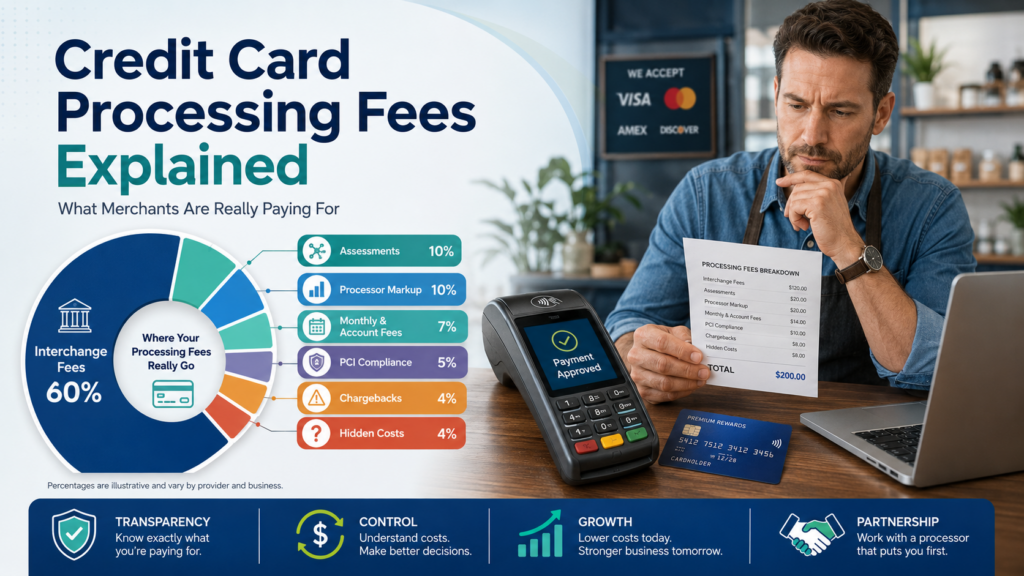
Interchange Fees: The Largest Cost
Interchange fees are your largest component of the cost of processing transactions. Interchange fees are determined by card organizations and paid out to the bank that issues the credit card used by your customer. They change according to variables such as credit card type, payment method, and even the kind of business you run. Reward cards and online transactions tend to be more expensive than basic card transactions in person.
Assessments: Network Fees
Transaction assessment fees are assessed directly by the card networks. The fees are lower than interchange fees but apply to each transaction nonetheless. They pay for the maintenance of the payment system infrastructure. Similarly, they are set at a fixed level and not negotiable.
Processor Markup: The Negotiable Piece
Here lies the profit for the processors. This cost is charged above and beyond interchange and assessment fees. These fees can be either a percentage or a fixed rate per transaction or a combination of both. The difference between this fee and others is that it is negotiable, making it one of the key criteria to consider while selecting a processor.
Monthly and Account Fees
Most providers tend to charge their customers monthly maintenance fees that can include statement fees, gateway fees, and minimum processing requirements. Even where you see providers offering free monthly fees, you need to be careful since the cost will be added to your transactions.
PCI Compliance Fees
PCI compliance fees are related to maintaining security standards for handling cardholder data. Some providers charge a monthly or annual fee to help cover compliance tools and support. Others may charge penalties if your business is not compliant, so it is important to stay up to date with requirements.
Chargeback Fees
When there is a disagreement about a particular transaction, that will lead to a chargeback. The problem with chargebacks is that not only do you lose out on making that sale but you can be charged extra fees for the trouble of handling the transaction.
Hidden Costs to Watch For
Most of the time, businesses will lose the most money on hidden fees. This can be a set-up fee, an early termination fee, a batch fee, or even a customer service fee. You should always check your contract and know all the fees associated with it.
Final Thoughts
Processing credit cards is not as straightforward as one would think. Through categorizing the fees that go with each type of transaction, you will be able to know what you are being charged for and how much money you might be able to cut out of your payments.